Pages

Infrared of isocyanates

Benzyl isocyanate

N=C=O stretch: This gives a broad intense absorption near 2270

Amine infrared spectra

Butylamine

Dibutylamine

Tributylamine

N-methylaniline

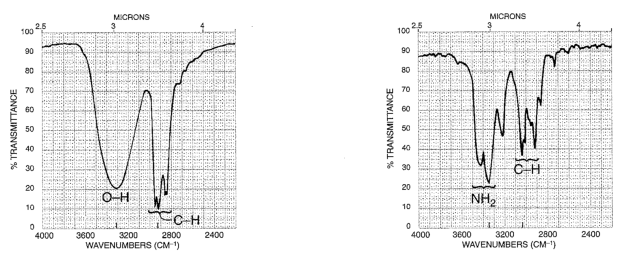
N-H stretch: At 3500-3300. This is split into two bands for a primary, one for a secondary, and is nonexistent for a tertiary amine. The intensity can be small for aliphatics, often vanishingly small for secondary aliphatic amines. For aromatics the stretch can be quite large.

The higher frequency band is from a symmetric vibration, the lower from asymmetric vibration.

In dilute solutions (non hydrogen-bonded) the peaks are shifted higher.

N-H in-plane-bend: A broad peak at 1640-1560 for primary amines. Secondary amines absorb near 1500. Can overlap a C=C peak.

N-H oop bend: Sometimes observed near 800, seen more easily in aliphatic amines.

C-N stretch: Occurs at 1350-1000, varying intensity. 1250-1000 for aliphatics, 1350-1250 for aromatics. The higher frequency in aromatics is from resonance increasing double-bond character between the ring and attached nitrogen.

For a neat liquid, the N-H peak is typically weaker and sharper than O-H:

Infrared of acid anhydrides

Propionic anhydride

C=O stretch: Always has two bands, 1830-1800 and 1775-1740, with variable relative intensity.

C-O stretch: Multiple bands at 900-1300

Infrared spectra of acid chlorides

These show a strong C=O band at 1810-1775. Acid chlorides and acid anhydrides are the main functional groups which show a C=O band at such high frequency.

There is also a C-Cl stretch from 730-550. This often splits into up to four peaks, due to different possible conformations.

Acetyl chloride
Benzoyl chloride - note the C=O shifted by conjugation

Alkyl and aryl halide infrared spectra

It is difficult to determine the presence of halides using IR, since they absorb at very low frequencies, in the fingerprint region. Mass spectroscopy is a much easier method.

C-F: Strong stretch at 1400-1000, polyfluoroalkanes give multiple bands.

C-Cl: Strong stretch in aliphatic chlorides occurs at 785-540. Primary chlorides absorb at the upper end, tertiary chlorides absorb near the lower end. Two or more bands may be observed. CH2-Cl wagging is at 1300-1230.

C-Br: A strong stretch at 650-510. This is out of the range (650) for typical NaCl IR cells, but using more expensive KBr cells will extend the visible region down to 400, allowing this to be seen. The trend for aliphatic chlorides holds for bromides. Aryl bromides absorb at 1075 and 1030. CH2-Br wagging is at 1250-1190.

C-I: A strong stretch at 500-485 for aliphatic iodides, out of the range of typical NaCl cells. Same trends for aliphatic iodides as aliphatic chlorides. CH2-I wagging at 1200-1150.

Carbon tetrachloride

Chloroform

Nitrile infrared spectra


Butyronitrile

Benzonitrile

Aliphatic nitriles absorb near 2250, while aromatic nitriles absorb near 2230.

The CC triple bond absorbs near here, but usually gives a weaker and broader band unless it is at the end of a chain.

Amide infrared spectra

Amides show a very strong C=O peak at 1680-1630.

Primary amines give two N-H stretch peaks, one near 3350 and one near 3180, from asymmetric and symmetric vibrations respectively.

Secondary amines give one N-H stretch peak at 3300

N-H bending at 1640-1550 for both secondary and primary amides.

N-methyl acetamide

Note how the C=O partially overlaps the N-H bend.

For dilute solutions the C=O is found at 1690. This is for the same reason as carboxylic acids - hydrogen bonding normally lowers the C=O frequency.

Like other carbonyl compounds, the C=O stretch frequency increases with decreasing ring size, by about 40 per carbon removed.