Pages

Hyperconjugation


Organotin and organolead compounds

Organotin compounds are used in antifouling agents, such as on ships and wood preservative. They are also added to PVC to prevent being degraded by the atmosphere.

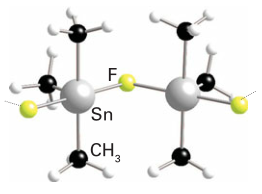
Halide derivatives, R3SnX, often contain Sn-X-Sn bridges and form chains. Bulky R groups can affect this. For example, (SnFMe3)n has the Sn-F-Sn backbone in a zig-zag arrangement.


Alkyltin compounds can be prepared from tetrachlorotin, using Grignard's reagent:


They can also be prepared by metathesis between chlorotin and alkyl aluminium:


Tetraethyl lead produced on a huge scale as an anti-knocking agent in petrol. It can be made using Grignard's reagent. This time producing a mole of Pb:


Like alykl silicon, alkyl lead can also be made from alkyl lithiums:


Lead can also contain bridging halide atoms, if the R groups are not too bulky.

Organosilicon compounds

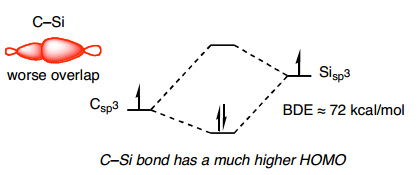
The carbon-silicon bond is strong and its compounds are fairly stable. They can be prepared with silicon chloride and alkyl lithium:


The number of chlorides replaced depends on the ratio of reactants.

Converting silicon metal to methylchlorosilane can be done using chloromethane and a bit of copper. This is called the Rochow process:


n can take the value of 1 - 3.

Chloromethane can then be hydrolysed to trimethylsilanol:


Which condenses to a dimer:


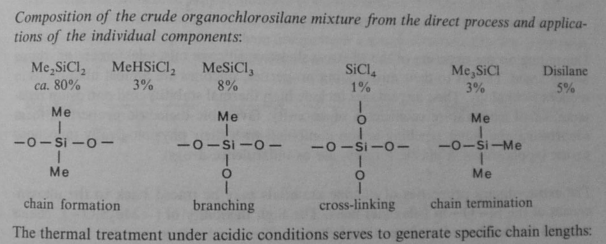
With Me2SiCl2, this forms chains or rings called silicones - molecules with a Si-O-Si backbone. The Si-O bond is much stronger than Si-Si, and is similar in strength to a C-C bond, so it allows very long chains.

Larger numbers of chlorides, when hydrolysed, produce branching and cross-linking:


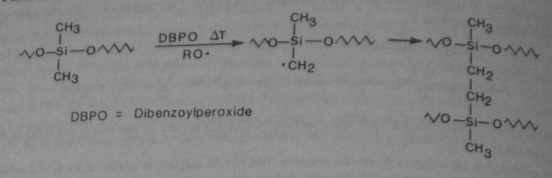
Branching between methyl groups can also be achieved. This is done by using Benzoyl Peroxide, a radical initiator:


Liquid silicones are more stable than hydrocarbons, and have a much lower change of viscosity with temperature. Thus they are used in brake fluid.

Silicones are hydrophobic, so they are used in water-proof sprays for shoes.

Low-mass silicones are used in shampoo, conditioner, shaving foam, hair gel, and toothpaste, to impart a silky feel.

Larger-mass greases, oils and resins are used for sealants, lubricants, varnishes, and synthetic rubbers
Group 14

Carbon and Silicon are non-metals, Germanium a metalloid and lead a metal. The metallic character down a group is associated with:

1. Lower ionization energy, making them more willing to form cations and lose electrons into a "sea".
2. More diffuse shells, meaning less directional bonding.

Carbon and silicon have a high affinity for hard anions such as O2- and F-. The heavier group 14 elements such as lead prefer soft anions such as I- and S2-. Hardness refers to small radii, high oxidation states and low polarizability.

All group 14 elements form tetravalent hydrides (EH4, catenation (bonds between the same element) decreases down the group. This is associated with decreasing E-E bond entropy.

The largest silane (SinHn+2 chain that can form is heptasilane. Silicon's larger number of electrons means more intermolecular force. So while propane is a gas at room temperature  trisilane boils at 53 degrees.

Something called the inert-pair effect increases down the group, which results in a tendency to form +2 rather then +4.


NMR 4

One of the most deshielded protons found in organic molecules is an aldehyde protons, at shifts of 9 to 10 ppm:


The resonance is 1 or 2 ppm higher for carboxylic acids, due to this resonance form:


If the solution is concentrated enough for hydrogen bonding to take place, it will deshield these hydrogens even further:

NMR 3

Protons found in chemically equivalent environments usually have the same chemical shift. Below are some examples. These use spectra predicted by a computer program, so the actual location of the shift is not very reliable.

One environment:


Two environments:


Three environments:


In H1 NMR, the area under each peak is proportional to the number of protons generating that peak. NMR machines typically integrate (find the area under) the curves automatically, which is often represented as an additional line. The example of benzyl acetate is below:

Benzyl acetate NMR

You can tell from the molecular formula that there are three H environments (assume the aromatic protons are in resonance), populated in a 5:3:2 ratio. The integrals on the spectra reflect this.

Note that integrals give relative numbers, not absolute numbers. There needs to be more than one peak for the integral to be useful. Integrals also have quite a large error range, of about 10%. Forgetting this error range is a common mistake on spectroscopy exams - where students find the correct formula but believe it has the wrong number of hydrogens.

The shift of each peak also tells us about the environment of those protons, for example, aromatic protons are typically found between 7 - 8 ppm, and methyl groups between 0 - 2 ppm. You can find good charts for these in the "spectroscopy data" link at the top of the blog.

You should also remember that deshielding shifts peaks to the left. Electronegative atoms like oxygen will inductively deshield nearby atoms. In the molecule above, the CH2 is next to an oxygen, while the CH3 is two bonds away, hence the CH2 is more deshielded. The even higher amount of deshieldling for the aromatic molecules are explained by magnetic anisotropy, described in a future post.

NMR 2

When a nucleus is shielded by electrons, these circulate to partially counteract an external magnetic field. This is circulation is called a diamagnetic current. The shielding effect produced  by this current is called diamagnetic shielding.


So heavily shield protons experience a reduced magnetic field, hence a reduced energy gap, hence they absorb light at a lower frequency. Deshielding therefore increases the frequency of absorbed radiation.

Rather then measuring frequency of absorption directly, NMR usually measures absorption relative a reference compound. The most common reference is tetramethylsilane:


This is chosen because its protons are more shielded than usual. This prevents overlap with protons on most organic molecules.

The frequency which a proton absorbs at also depends on the magnetic field strength of the NMR machine, which varies according to research budgets, since strong magnets increase the resolution, but are more expensive. To allow easy comparison of specta, the field-independent frequency can be measured using chemical shift notation (δ).


The (shift in Hz) part refers to the shift relative to tetramethylsilane or another standard. Since this is divided by MHz, then chemical shift could also be described as "shift from tetramethylsilane in parts per million of the spectrometer's operating frequency".